
How to Choose the Right Sachet Filling Machine?
Choosing a sachet filling machine is not just a speed decision. It is a product, package, and process decision. The wrong setup can leave powder on sealing surfaces, create uneven liquid fills, or produce sachets that feel inconsistent in the hand. The right one should match your product’s flow, target fill weight, film structure, seal requirements, and cleaning routine.
Industry reports help explain why the choice matters. Grand View Research estimated the global flexible packaging market at USD 260.8 billion in 2023, reflecting the scale of demand for lightweight formats such as sachets. PMMI’s packaging machinery research also highlights manufacturers’ continued investment in automation and operational efficiency. These figures describe broad markets, not sachet machines alone, so they should guide context—not replace equipment trials. Ask suppliers to test your actual product and packaging material. Watch the seals. Check the fill variation. See how quickly operators can clean the parts that touch the product.
One caution: I could not verify a named sachet-filling-machine expert’s attributable quotation from the information provided, so I will not invent one. A sound selection principle is simple: choose for repeatable performance, not the fastest number on a brochure. A small trial can expose awkward changeovers or messy dosing. Those details matter. This guide will help compare machine types, dosing systems, materials, output, and supplier support—while leaving room to challenge assumptions before you invest.
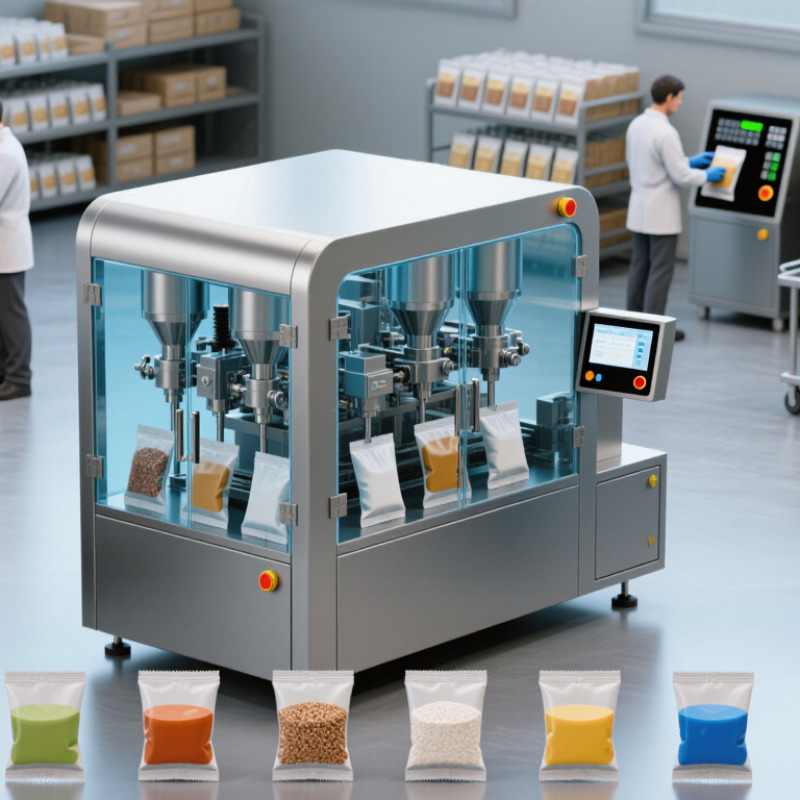
Define Your Product, Sachet Format, and Production Requirements
Choosing a sachet filling machine starts with the product, not the machine. Powder, liquid, granules, and viscous pastes flow differently. A fine powder may bridge inside the hopper. A sauce may drip after sealing. Test the real product at its normal temperature and moisture level. Record fill accuracy, seal strength, dust, and cleaning time.
Your sachet format also sets the machine’s limits. Define the sachet width, length, seal style, film structure, and tear direction. A four-side seal needs different tooling from a three-side seal. According to the Flexible Packaging Association’s 2024 State of the Flexible Packaging Industry Report, U.S. flexible packaging sales were about 40 billion dollars in 2023. This scale reflects strong demand, but it also raises quality expectations. The FAO reports that 13.2% of food is lost between harvest and retail. Accurate dosing and reliable seals can reduce avoidable product loss.
Tips: Start with your slowest product. Measure changeover time with an operator, not a brochure. Ask for a factory trial using your film and product. Check whether the machine can handle small batches, because planned production often changes. A high-speed model may look efficient, yet frequent cleaning can erase its advantage. I would not trust a single test run. Dust, humidity, and operator habits can change the result. Leave space for inspection access, spare parts, and future format adjustments.
| Product Type | Key Product Characteristics | Common Sachet Formats | Suitable Dosing Method | Important Machine Requirements | Production Planning Considerations |
|---|---|---|---|---|---|
| Free-flowing powders | Fine or medium particles that pour consistently; dust may be generated during filling. | Three-side seal, four-side seal, or stick pack | Auger filler; a cup filler may suit some free-flowing products. | Dust control, product-contact parts suited to the powder, and accurate auger adjustment. | Confirm target fill weight, powder bulk density, dust handling, and the required number of lanes. |
| Granules and crystals | Discrete particles with consistent size and flow, such as sugar or salt. | Three-side seal, four-side seal, or stick pack | Volumetric cup filler or multihead weigher, depending on the required accuracy and product. | Product flow paths should limit bridging and particle damage; verify the dosing system suits the particle size. | Check particle size distribution, target weight, settling behavior, and whether weight-based dosing is needed. |
| Low-viscosity liquids | Pourable liquids that flow readily; foaming or splashing may occur with some formulations. | Three-side seal or four-side seal | Liquid piston pump or another metering pump selected for the product. | Use compatible product-contact materials, controlled filling, and a sealing area kept clear of liquid. | Assess viscosity, foaming, temperature, fill volume, and whether the product contains particles. |
| Viscous pastes and sauces | Thick products that move slowly and may contain suspended ingredients. | Three-side seal or four-side seal | Piston pump or a suitable positive-displacement pump. | Confirm the pump and nozzle can handle the viscosity and any particles; allow for effective cleaning. | Test the product at operating temperature and check dosing consistency, nozzle cutoff, and cleanability. |
| Gels and creams | Semi-solid products that may be shear-sensitive or temperature-sensitive. | Three-side seal or four-side seal | Piston or positive-displacement dosing system selected through product trials. | Consider gentle product handling, temperature control if required, and compatible seals and tubing. | Define acceptable fill tolerance, product temperature range, cleaning method, and changeover needs. |
| Products with mixed particles | Liquid, paste, or powder containing pieces that must remain evenly distributed. | Three-side seal or four-side seal | Specialized pump, auger, or combined dosing arrangement based on particle size and formulation. | Check passage dimensions, agitation requirements, and the risk of particle damage or separation. | Run trials using the actual product to verify portion consistency, particle distribution, and reliable sealing. |
Selection note: Confirm the final machine configuration through product and packaging trials. Actual output depends on fill volume, product behavior, sachet dimensions, sealing conditions, number of lanes, and changeover requirements.
Related Posts
-
Best Sachet Filling Machine for Global Buyers in 2026?
-
2026 Top Form Fill Seal Machine Trends for Global Buyers?
-
Top 10 Tray Sealer Packaging Machines for Global Buyers?
-

How to Choose the Right Sachet Filling Machine for Your Business Needs?
-
Why Choose a Tray Sealer Packaging Machine for Your Business?
-
Top 10 Form Fill and Seal Machines for Global Buyers?

Products
Links
© Copyright 2025 | All Rights Reserved